
Fluffmobile research
Why do big dogs die young?
An elephant tends to outlive a mouse. Put two dogs side by side and the pattern flips. The little one often has more years ahead.
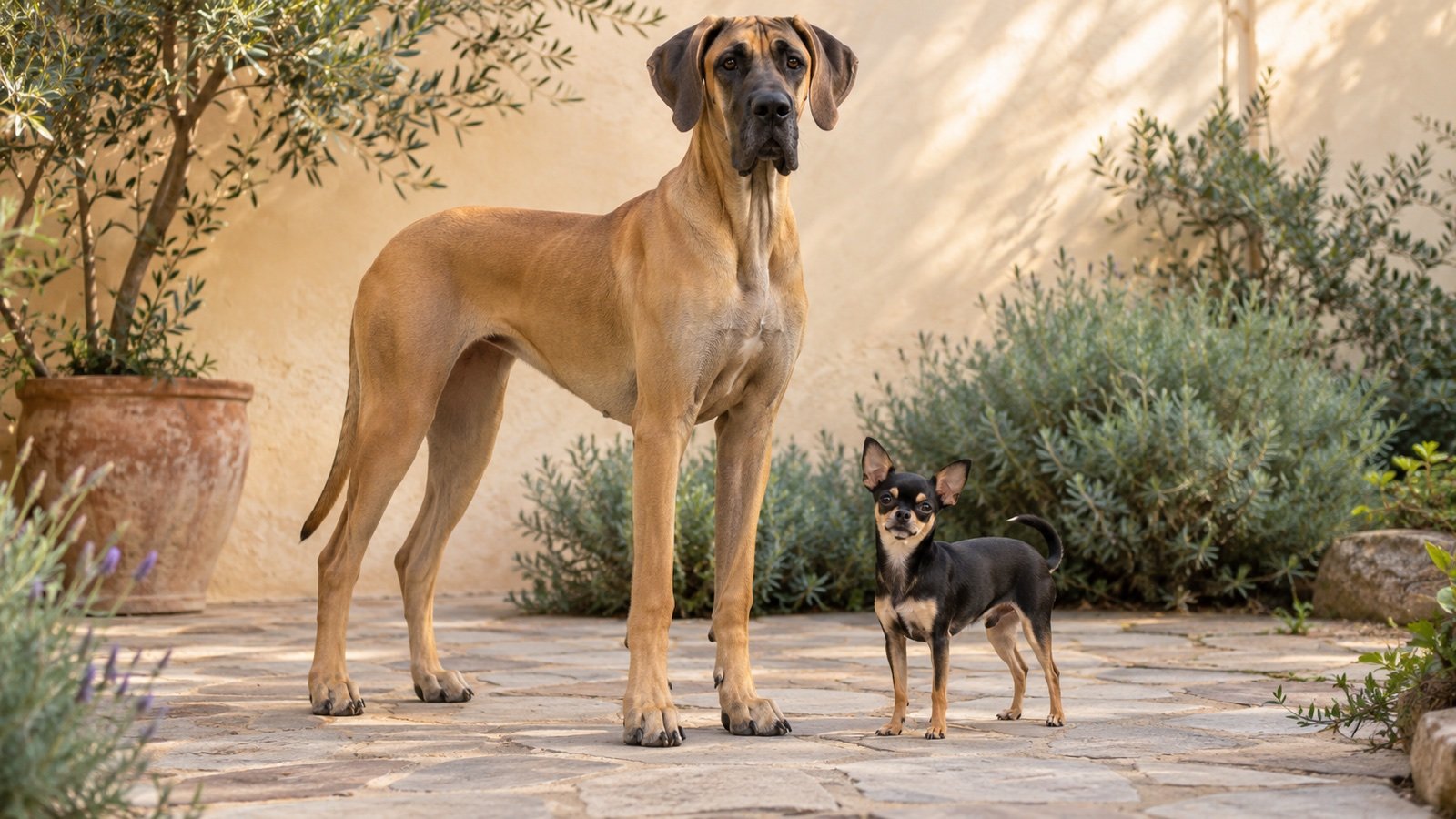
In the Dog Aging Project, small dogs lived around 14 years at the median. The median was under 10 years for giant dogs of recognized breeds. A median is the age at which the study estimates half the group is still alive. The gap is real across groups, even though dogs of the same size can live for very different lengths of time. Chiu and colleagues, Table 2
Compare dogs by adult weight
The US study also grouped dogs by the weight their owners gave. Pick a weight to see the results. The pound labels are rounded.
Under 10 kg
13.6 to 14.2 years
These are the lowest and highest medians across groups split by sex and breed status. Dogs can live beyond either end. Dog Aging Project, supplemental weight analysis
The pattern shows up in more than one study
One US team used vet records to build a life table. That is a way to estimate how many years a dog has left at each age. At birth, the estimate was 13.53 years for small dogs and 9.51 for giants. The numbers are averages from the life table. The tool above shows medians, a different measure. Montoya and colleagues, Supplementary Table 7
A large UK study also found a gap. It estimated medians of 12.7 years for small purebreds, 12.5 for medium ones and 11.9 for large ones. The teams used different size groups and records. The gap changes, but the trend holds. McMillan and colleagues, survival analysis
Big dogs seem to age faster
Think of the risk of death as a line that rises as a dog grows old. A big dog might start higher on that line. The line might turn up sooner. Or it might get steep faster. Those ideas sound alike, but they make different shapes on a graph.
Researchers fitted those curves for 74 breeds. Bigger dogs had a slightly higher risk at the start of old age. The age when the line began to rise showed no clear link to size. The strongest link was how steeply death rates rose after that point. In large breeds, the added risk grew faster as the dogs got older. That is what the study means by faster aging. Kraus, Pavard and Promislow, Figures 2 and 3
Growth may come with a cost
People bred dogs for very different jobs and sizes. A Great Dane builds a much bigger body than a Chihuahua. Part of that gap lies in a gene called IGF1. It helps make IGF-1, a signal that tells cells to grow. A version of the DNA near that gene was common in small breeds and rare in giants. That finding helps explain size. It leaves open how much the gene affects lifespan. Sutter and colleagues, Science
Making more cells gives more chances for errors as cells copy their DNA. Some errors can help a tumor grow. That is one idea for why cancer accounts for more deaths in many large breeds. Growth speed, time to reach full size and the number of cells are different things. The studies cannot pin the lifespan gap on one of them. Nunney, Royal Society Open Science
What dogs die from also changes with size
In North American teaching hospitals, tumors made up about half of the classified deaths in Bernese Mountain Dogs and Golden Retrievers. Injuries led in several toy breeds, including Chihuahuas and Toy Poodles. Those hospitals see hard cases, so the shares may look different in the wider dog population. Fleming and colleagues, Table 2 and discussion
Cancer also varies within big breeds. A study found that cancer deaths rose with breed size, then leveled off among the heaviest breeds. Dogs that die younger have fewer years in which cancer can appear. Size helps explain the broad pattern, and breed matters too. Nunney, Royal Society Open Science
Size does not tell the whole story
In the UK survival study, Labrador Retrievers had a median of 13.1 years, compared with 9.0 for Mastiffs. The small French Bulldog had a median of 9.8 years. In a separate UK study, the French Bulldog life table gave 4.53 years at birth. That study drew from a different set of records, and the breed's fast rise in popularity left a young group to study. Both results need their own context. McMillan, Figure 3 and Teng, Table 3 and discussion
Body shape and family history can matter. Flat-faced breeds had shorter median lives as a group in the UK study. In a separate study of Golden Retrievers, dogs whose parents were more closely related tended to die younger. These links help explain why a weight chart alone can miss risks. McMillan and Yordy and colleagues
Why the elephant can still outlive the mouse
Looking across species gives a different view. A large mammal often lives longer than a small one. Species have had very different histories of growth, danger and survival. For example, in a large study of birds and mammals, animals that could fly lived longer even after the team took size into account. Healy and colleagues
Large species may also have ways to keep cells from turning into tumors. One study of zoo mammals found little link between body size and deaths from cancer across species. Dog breeds share a much more recent history. Breeders could change size fast. Whether the body's defenses kept pace is still an open question. Vincze and colleagues and Nunney
Related reading: What helps pets live longer?